There’s a worry that weighs heavily on the minds of vehicle owners who want to be more than just casual vehicle owners. These owners are interested in knowing more about their vehicles, taking the all-important step of fixing them directly when an issue arises and figuring out the best OBD2 scanners generally for a task. This callenge is whether they should get a simple code reader or a professional scanner instead.
You see, the attraction to the features a pro scanner offers is seductive. Just like the truck you’re never going to take off-road, tow, or haul anything serious with, the feel of a brand-new professional OBD II scanner and the list of all the things it can do are truly hard to resist.
But, in reality, won’t the small, humble code reader serve better (at least for your needs)? Isn’t it all you may require in the true sense?
This is difficult to tell, conclusively, especially if you’re new to the world of auto DIY. Or, you’re simply interested in taking your vehicle’s health into your own hands and positively deciding things directly.
Not to worry, though: today, I’ll help you decide whether you need to invest money into a professional scanner or if a small, basic, glove box-friendly code reader is all that you need.
After all, I know, you won’t want to make the mistake you made with the truck when a simple sedan was all that was truly needed.
Let’s get to it! But, first things first: why’s an OBD II reader important and why should you consider buying and owning one in the first place?
Affiliate Disclosure
I’m a participant in the Amazon Services LLC Associates Program. As an Amazon Associate, I earn from qualifying purchases when I link to Amazon.
Article Outline
Why an OBD II Reader Is Non-Negotiable
Before 1996 (at least for the US), it wasn’t a federal requirement for vehicles made for the US market (or vehicles made in the US – there’s a difference) to have the OBD II port and general OBD II protocol compliance.
After 1996, things changed, however. All new cars made (in or for the US market) needed to comply with the new regulation, taking the guesswork off vehicle fault detection and reporting.
What this means is simple and devilishly effective: your vehicle runs tests, all the time, and reports back, via specialized codes, if anything’s wrong. It also, via live data, gives you a firsthand glimpse into how the system’s running.
For a modern vehicle, this data and its retrieval are priceless; it helps you, auto DIYers, and mechanics process repairs accurately, eliminating guesswork (almost completely) from the equation.
This is why, if you need your vehicle to run right (and keep running right), an OBD II code reader (at least) is a non-negotiable addition to the things you need to buy, own and ultimately, keep around.
Unfailingly.
So, what’s the difference between an OBD II code reader and an OBD II scanner? It turns out that there’s a lot separating these two otherwise similar devices.
The Difference Between an OBD II Code Reader & an OBD II Scanner
An OBD II code reader is a simple OBD II machine that retrieves stored codes, presents them, and usually, is also able to delete same. Generally, OBD II code readers are capable of reading engine and emission codes only and may, in addition to clearing such codes, also display the associated freeze frame data and, in some cases, feature a code library (that retrieved codes can be looked up against).
The traditional display size of the code reader, by default, is also usually not more than 2-4 inches, given that they do little beyond the basics.
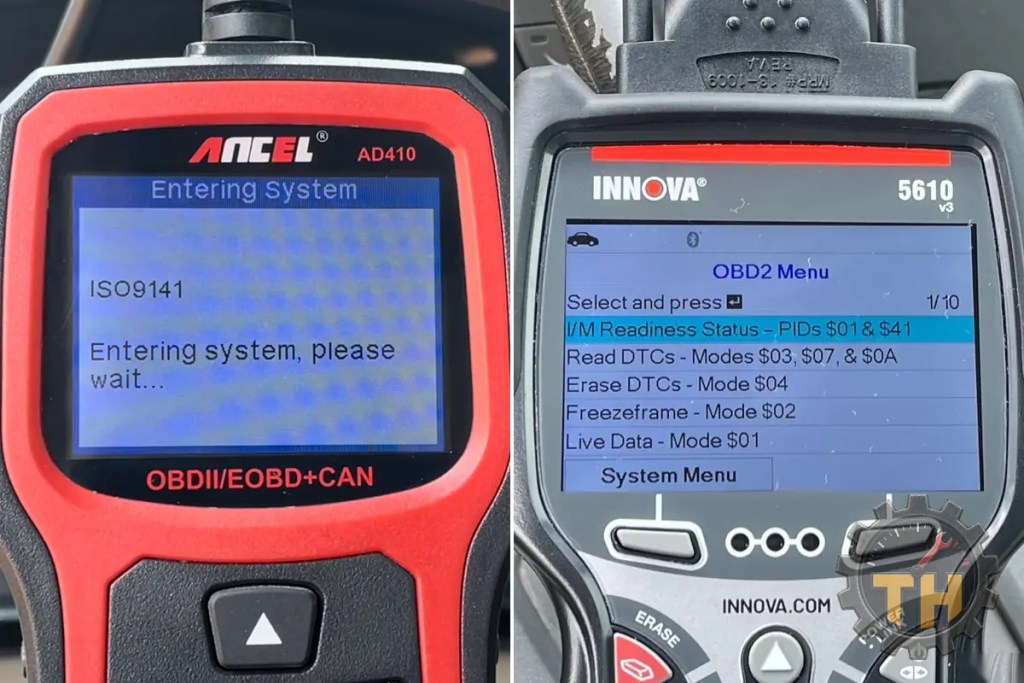
A good example of a code reader is the Ancel AD410, shown in red in the photo above.
On the other hand, OBD II scanners do everything code readers do and then do some more, depending on make or model. However, as a general rule, OBD II scanners are expected to have the ability to scan all of a vehicle’s modules, which include (but aren’t limited to) engine, ABS, transmission, HVAC, and TPMS.
Depending on the make and model in question, OBD II scanners can also carry out a number of resets and do such complex things as program keys.
Generally, scanners offer a more impressive screen display, and as a direct consequence of their features, they also cost way more than regular code readers.
A good example of an OBD2 scanner is the Innova 5610 shared in the photo (grey, right) above
What an OBD II Code Reader Does Best
At its heart, an OBD code reader is designed to read engine and emission codes, understand what they mean, and delete them (if and when the need arises).
It’s the glove box unit that you plug into your vehicle’s OBD II port (DLC) when you see a strange code pop up on your vehicle’s instrument cluster.
It’s simple, nothing special.
In summary, an OBD II code reader reads engine and emission codes and erases them, best, hardly doing anything more than this.
By extension, it also lets you know, via the I/M function most of them sport, if your vehicle is ready for emission testing (if you live in a place where this is mandatory).
What an OBD II Scanner Does Best
On the other hand, an OBD II scanner performs best when the entirety of the OBD II modules needs to be checked. It’s also useful when you need to check systems that typically won’t throw a CEL on the cluster when things go bad (or need attention).
For those who are adventurous and interested in making the most out of their vehicle use experience, an OBD II scanner can also run a series of resets and is capable of doing such advanced things as key programming, if need be.
An OBD II scanner is also the unit you’d trust when going for a vehicle inspection, if you’re to burst check engine light scammers right in their butts.
FAQs
Besides the explanations and differences offered regarding whether or not you should buy an OBD II code reader or a pro scanner (instead), below are a few questions that are frequently asked.
The answers to these questions will help illuminate the topic in a rare but consistent manner.
1. What Does a Code Reader Do?
A code reader retrieves stored engine and emission codes and explains what could be wrong with an engine by deciphering the code (or codes) into intelligible renderings.
2. Which Is Better, a Code Reader or a Scanner?
Neither. It depends on what you intend to achieve with each, and importantly, your proficiency level with OBD II machines.
3. How Do You Use an OBD II Code Reader or Scanner?
You connect the OBD II code reader or scanner to the vehicle’s Diagnostic Link Connector (DLC) and follow the prompts on the screen to use it.
4. Can Code Readers Clear Codes?
Yes – if it’s equipped to clear codes. Why common today, some code readers can only read codes and not clear them.
5. Can I Use My Smart Smartphone as an OBD II Scanner?
Yes, as a monitor, sort of. You’ll need an OBD II dongle capable of establishing a wireless connection with your smartphone to fully turn your phone’s display to act as an OBD II scanner/code reader interface.
A Code Reader or a Pro Scanner: Which OBD II Machine Will Serve You Better?
It depends on what you’re looking for in an OBD II machine and your general interest/ability in cars.
If you’re a casual owner who simply loves to check up on your vehicle occasionally and maybe know what could potentially be the cause of a check engine light or drivability challenge (before taking the vehicle to a mechanic), your best bet is a cheap and simply made unit, like the Ancel AD410.
On the other hand, if you’re looking to dig deeper into your auto challenges and fix things yourself (now or in the future), your best bet is a pro scanner (like the Innova 5610).
Now, here’s the trick: even if you believe you’re going to need many features down the line, don’t jump at it and believe you’re making a smart decision…from experience, you WON’T need more than 90% of the features, a good professional scanner offers especially if you don’t run a shop (or at least, have a fleet you manage).
The sweet spot?
Get a prosumer-conscious scanner and save some bucks: it’s the best of both worlds, and it’s difficult to see how you’d go wrong with it.
Love the Above? Subscribe for More

Throttle Lan
DIY Mechanic and Freelance Auto Writer